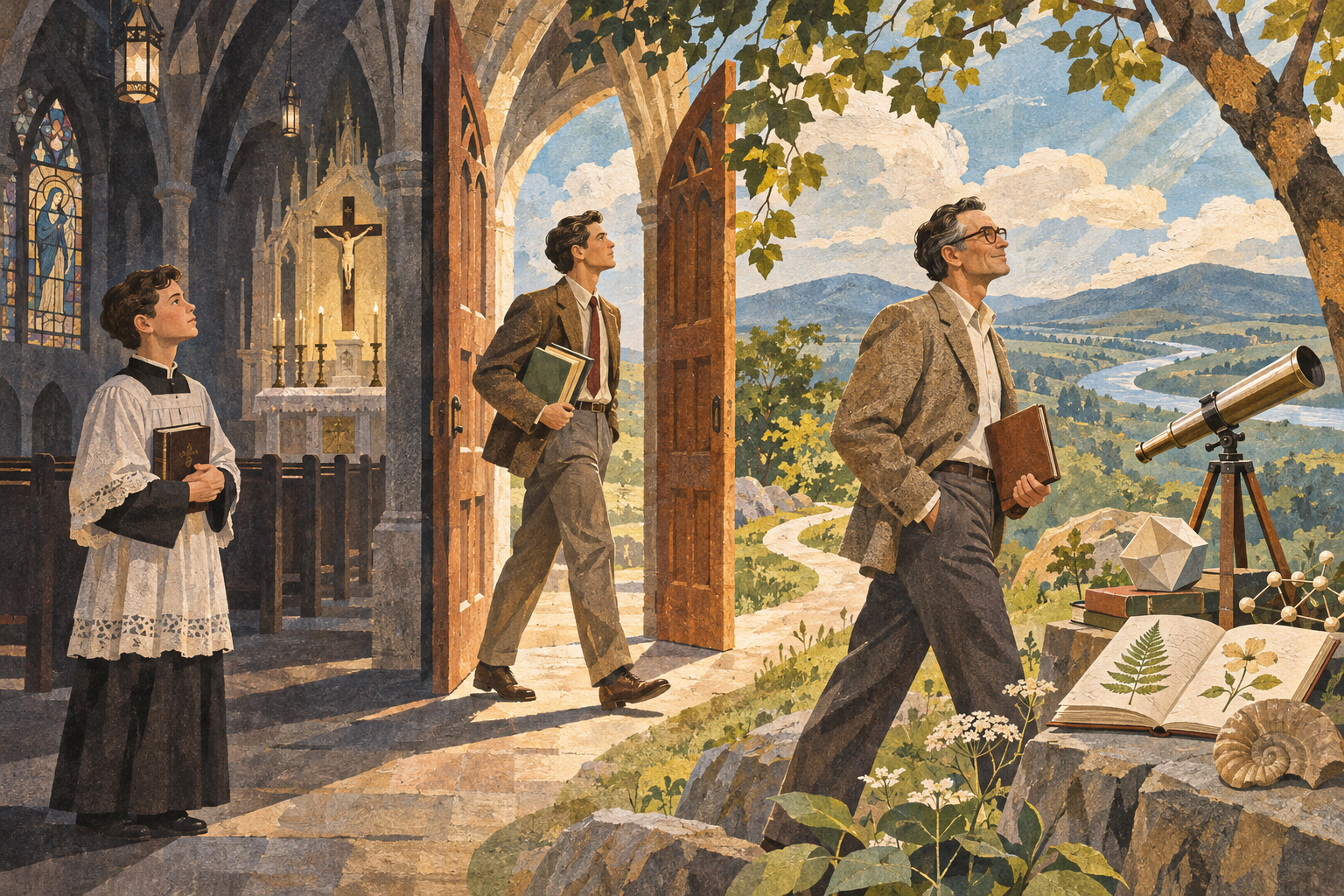
Life is not without struggles. We are born, we die, and in-between we learn, grow, feel happiness, sadness, love, romance, anger, hate, depression, despair, and ecstasy. These are just a few of the cars on the emotional roller-coaster we all ride. Life is one long research project to build our character, personality, and beliefs. Along the way many different roads are taken which shape us. When young, the innocence of ignorance makes us vulnerable to what is fact or fabrication, for we have no basis for acceptance other than the person instructing us intentionally or unintentionally. As we mature, we come to clearly see truth and lies, facts and fiction, reality and conspiracy theories. We finally stop merely accepting faith alone and instead use reason, logic, and science. Too, we halt simply conforming, and in its place adopt a pragmatic platform based on truth. This is a journey from early development to adult wisdom, and the progression of the many factors that fashions belief, faith, and a realization of fact and certainty.
Part I — From Altar Boy to Atheist
Tommy was the youngest of three children born in 1944. His dad died in 1949 at thirty-seven years old, which means Tommy’s early memory begins after five years of age, for he owns no memory of his father. He had a good home life, but with a dysfunctional sibling and parental dynamic getting in the way of shared family love. Having no father image or influence his sole source of education on emotional love was his mother who wholly lacked the ability to show affection or love in any physical or emotional way. He had no mentor to teach him those important articles of life. All children desire and need both demonstrative and poignant love from a parent, and when lacking, the void is filled with uncertainty and doubt leading to a lack of self-esteem and self-worth rendering open vulnerability. A child devoid of affectionate hugs, kisses, and never once hearing the words “I love you” from a parent lacks an essential component of early tutelage.
Tommy’s sister Carol was three years older. A bright and bubbly young girl who made friends easily. Always busy with little-girl things, and three years older, she and Tommy didn’t develop a close relationship. They got along fine but circumstances never seemed to bring them together in any bonding way. When starting high school mom sent her to a boarding school to relieve herself of the burden of a teenage girl in the house. Thus, sister and brother didn’t have the opportunity to develop a closer friendship during their teenage years.
His brother Bob was seven years older. He was an intelligent and handsome boy. Because he was the first born, their mother devoted what little emotional love she did have to him at the expense of her daughter and younger son. As he matured, she saw him as a replacement husband allowing him to make many family decisions. Instead of seeing himself as a big brother to Tommy and bonding with him, he considered him as a bother, and distanced himself in every way. He spent no time with his little brother and wouldn’t include him in any activities.
Bob was the center of mom’s attention at the expense of her Tommy and Carol. She involved Bob heavily in the church and from an early age saw him as a priest. She pushed him hard toward the priesthood and he liked what he saw and felt. Instead of starting high school, she sent him to a seminary. Bob walked on water because he was studying to be a priest.
His mother was a devout Catholic and bathed her children in the church she so much loved. She was active in every manner of church activities involving her kids as much as she could. Thus, at a very early age Tommy found solace and belonging in church activities. He attended a Catholic school adding to the influence of religion on his thought process.
Tommy was immersed in the church and it provided a belonging he desperately needed. His mom provided all the material necessities of life, but none of the emotional components. There was no affection whatsoever, no hugs or kisses, and no words of praise, compliments, recognition, or a spoken “I love you” from his mother. His emotional elements were the church and the pastor who noticed him and showed concern. This helped Tommy by giving him some bit of attachment.
At an early age of twelve the parish priest he admired asked Tommy to become an altar boy, of course he agreed. He was trained by a seasoned altar boy, learned all the Latin responses quickly as well as the procedure for serving a mass. He served a number of masses with his teacher to learn the technique. One Sunday after dressing to serve the mass, he was told by the priest that the other altar boy was not able to make it. He was terrified. There had always been the two of them, but now he was solo. Everything was up to him.
When the priest told him, he responded, “But I’ve never served alone Father.” The kindly priest looked at him and said, “Tommy, you have served several masses, and I know you will do just fine.”
Tommy was nervous, but everything went according to plan and he excelled. When he and the priest reached the sanctuary after the mass, the priest said, “Tommy, you are one of the very best altar boys I have ever had. Thank you.” Bashful, Tommy nodded slightly saying “Thank you, Father.”
Tommy went on to serve mass every Sunday and was often asked by the other priests if he would serve their later mass as well, which he gladly did. He received many accolades and compliments, something he never received at home. He loved the church, and the pastor cared greatly for him. The pastor took him fishing, which was something his brother would never do. When Bob said he was going fishing with friends, Tommy would ask if he could go with them, but the answer was always no.
Tommy would go to confession because it was something he was told to do. He didn’t have real sins to confess, so he would pick a number and say he had bad thoughts ten times, and bad actions with himself five times. He would be given his penance of five Our Fathers and ten Hail Marys and be on his way.
He accepted everything he was told in church and in the Catholic school. He learned about the Ten Commandments, the burning bush, and the separation of the Red Sea so the Israelites could cross the Red Sea to escape. He never questioned anything no matter how silly it seemed. He never wondered why God would punish all of mankind so severely and toss Adam and Eve out of the Garden of Eden just because Adam took a bite from an apple. He never thought to question why an all-loving God would let someone nail his own son to a cross to save humanity, when humanity surely wasn’t saved. He knelt every Sunday in front of a cross with the figure of a man nailed to it with a crown of thorns on his head and a stab wound in his side. He never questioned such a thing for he believed what he had been taught.
His belief in God was solid as well as his belief in prayer. He would often kneel in church and have a one-way conversation with God asking for help in any number of needs and desires. He knelt beside his bed every night to say his prayers believing without a doubt that God heard him. He served mass at his brother’s ordination in their church, and when the priest washed his brother’s feet, he was shocked wondering what that had to do with the priesthood.
Rather than apply to a local college, Tommy’s love of God drove him to apply to Marquette University. He spent his first year as a liberal arts student and took his love of God and church with him to college. During his first week at Marquette, he purchased texts for his classes. In the bookstore he picked up a black, soft-covered bible, held it in his hands and knew he had to own it. It was expensive, yet he felt it would somehow help him. It felt formidable, and he was proud to carry it around the campus.
It was November 22, 1963. President John F. Kennedy had been shot in the head by an assassin and taken to the hospital. This event was the trigger which initiated Tommy’s skepticism and final disbelief in the church and existence of God. He was in his dorm room, depressed, walking in circles, listening to the radio, waiting to hear Kennedy was okay. Every second was tortuous; This can’t be, this can’t be, this simply can’t be happening he thought. The desks of Tommy and his roommate faced each other, their bunk beds filled a corner, the large stereo speakers he had made stood as sentinels on each side of the window, and his thrift store rocking chair with the cushion his mom made was waiting for him to sit and study. Tommy stood looking out the window into eternity, his mind raging with fury and depression, for he loved and admired Kennedy.
When he heard the words he would never forget, “John F. Kennedy, the 35th president of the United States died at 12:30 p.m.” his mind exploded in pure anger he’d never before felt. Chills filled his body, his ears burned, eyes blurred with tears, he was in a daze. He looked down at a speaker that had just made the horrid announcement, swung his foot back and kicked it with all his might. It slammed against the wall and toppled over. He sat on the edge of his bed, elbows on his knees, hands to his face, and wept in deep despair.
His roommate swung the door open and ran in shouting, “Kennedy is dead! God, he’s dead! The fuckhead killed him, he’s dead!”
He looked up at his roommate who saw no words were needed from Tommy. His roommate came over and sat beside him as silent tears rolled down their cheeks, their minds spinning, awash in disbelief and anguish. A long, depressing moment later Tommy went to his desk, pulled out the chair and sat. Nothing could be said—they just felt a powerful depression. His roommate noticed the toppled over speaker with a damaged fabric covering and knew why it was damaged.
A short time later a student flew through their door. “Jesus Christ, this is horrible, what’s going to happen now? I came to tell you at six there’s a memorial High Mass for Kennedy. We need to get there early; it will be packed.”
They headed for the cathedral. The sidewalks were full of students heading that way. No words could be heard. Other than the sound of footsteps the campus was dead quiet. Every student walked with their head down, some wiping their eyes. They entered, knelt, and only moments later every pew was full, and students filled the side aisles, and some sat on the floor in the center aisle. Everyone in the pews knelt, hands folded, praying in total silence except for the many girls crying, as well as some boys. The girl sitting next to Tommy was quietly crying, and tears were building in his eyes. Tommy thought about what Gandhi said, “To give service to a single heart by a single act is better than a thousand heads bowing in prayer.” He looked at her and wanted to give her a hug. Around him were hundreds of bowed heads in prayer, his included as he began to wonder what good it would do.
Tommy knelt, prayed, his new Bible in his hands and turmoil in his mind. Everyone quietly stood when from the back of the church came the procession. The pastor, several priests, some holding crosses, others incense burners, and a few altar boys. They spread out at the altar and the mass began. It wasn’t long when the pastor slowly climbed the stairs to the pulpit. Everyone sat waiting for his wisdom. He looked from side to side, up and down, taking in the packed church of distraught students and public. The priest stood in silence for a while—the only sound was muffled crying.
Tommy sat in the awe-inspiring cathedral he loved, the striking house of God. The priest looked out over all and began. “This day has devastated us all. Our beloved president, a wonderful man, John F. Kennedy was killed. He is no longer with us.” Many in the church began to cry less quietly. Tears flowed from Tommy’s eyes and his throat was cramped in pain. He wanted to bawl, and just let the tears flow freely.
The priest continued. “Let us pray for his family. We ask God in his goodness and compassion to watch over his wife and children and give them strength.” Those words, “God in his goodness and compassion” echoed in Tommy’s head igniting anger. His mind screamed, “What!” Those six words were the epiphany of epiphanies. In that instant Tommy lost his faith, realized prayer was a joke, and made the resolute conclusion that if indeed there was a God, he was either blind, or simply didn’t give a damn. The realization shocked Tommy to the core of his soul. They represented the nuclear missile that detonated in his mind the realization that religion, prayer, miracles, worshiping this God, whose son was hanging there in front of everyone, nails sticking out of his hands, and a crown of thorns on his head, bleeding in pain, stabbed in the side, was all a lie, a legend, a farce, with no basis other than faith in some sectarian fiction called the bible Catholics were told to believe.
Catholicism demanded belief, blind faith, with no questions asked. Tommy looked up at the cross, a human being with his head tipped to the side—a dead man nailed to some planks hanging in a wondrous building for us to worship, really? What kind of sick symbol is that? What kind of father would allow his son to be nailed to some timbers anyway? For what purpose? To save mankind? Hell, his son’s gruesome death sure as hell didn’t save anyone, nor did it accomplish one bit of good. Wars, murder, evil, rape, child molestation, and the death of wonderful people took place all the time for no reason. Millions of Jews gassed at Auschwitz. Just where was this all good and compassionate God while such evil took place? Was he vacationing during Hitler’s reign of terror, or when the rifle was aimed out the window at Kennedy, or did he just not exist?
Chaos propelled Tommy’s mind to near vertigo. Dizzy, perplexed with anger, he glowered at the man standing there high above everyone in his pulpit, telling them to beg this God to watch over Kennedy’s wife and kids. What, really! Who the hell was he to think if they all prayed, Kennedy’s family’s pain would go away. Bull Shit! Why did they have to purchase God’s empathy when he was told God is pure goodness. Did they all have to pay him by kneeling in prayer to bring out his empathy and benevolence? What’s with God’s goodness and mercy anyway? Miracles, really? If Jesus could part a whole damn Red Sea so worthy folks could escape their captors, couldn’t he have been gracious enough to make a puff of wind blow the goddamn bullet three inches to the right? Couldn’t his graciousness have wiggled the barrel of the rifle just a tiny bit when that asshole pulled the trigger? Why not a misfire? Why not just a small miracle that would have prevented all this suffering? Tommy realized miracles are but wishes of the faithful, unfulfilled yearnings, a ruse, a joke, a con.
Tommy could see the priest’s mouth move and hear the sound of his voice, but he only felt anger and disdain as he gazed up at the pitiful man hanging on the cross in front of everyone. Tommy was sitting in a building of fraud, a hoax, living within a counterfeit tale of God and his so-called mercy, love, and empathy—all made up ignorance. Tommy had to get out of there before he screamed the thoughts overtaking him. His hands gripped the Bible he carried everywhere. He looked at it, a scam, a con-game, a ridiculous storybook of lies to brainwash the faithful about the merciful deities called God, Jesus, and some Holy Ghost character he never understood—a ghost, really? Who was this Holy Ghost guy anyway, what was his responsibility, was he third in command? How dumb was it to add a ghost, of all things to a father/son relationship? And why does the Catholic church downplay moms, and have Mary be a virgin mother of all things, really? So, Joseph was a token husband to make her giving birth to a child acceptable because she was married? Tommy’s thoughts flew in every direction, and he wanted that priest to explain and correct his epiphany, but he knew his reply would be, “Have faith my son.”
Tommy looked at the bible in his hands. He no longer wanted to carry around a book of hypocrisy declaring to everyone he believed in such gibberish. He politely handed his once-cherished Bible filled with ridiculous and far-fetched stories of so-called miracles to the sad young girl sitting next to him. She took it in her hand as Tommy gave a slight nod, stood, made his way out of the pew, walked down the aisle toward the huge open doors and into the fresh air of realism—his exit from hypocrisy and entry into atheism.
For months Tommy struggled with his realization. His thought process took him to his past prayers and concerns. He thought about the thousands of hours he spent in church convinced what he had been taught was real. His mind took him to a myriad of so-called truths about God and prayer. He realized he couldn’t come up with a single time his prayer was answered. He thought about the many hundreds of hours he had knelt in prayer in church and at home. He tried to visualize if indeed there was a God, what it might look like in heaven with God perhaps sitting in his throne looking down at all the millions on earth praying for one something. He wondered how God selected those he would grant miracles to and answer their request. Maybe a miracle was granted based on how many prayed for the same thing. If a few people prayed to save a young child with cancer, was that enough or did it take an entire church full of people or maybe a whole town to purchase God’s gift? Or was it based on the severity of the problem? Did the Jews gassed by Hitler not warrant a miracle by an all-loving God who was entirely capable of saving them? Was Kennedy not a good enough person to deserve God’s miracle? Did the tiny infant involved in a mortal car crash not merit God’s goodness? Tommy couldn’t fathom a process used by God to create a miracle, and he concluded once again that prayer and faith were a self-manufactured nonsensical and unreasonable beliefs, and the so-called miracles in the bible were fictional stories to give great power to a nonexistent god. Yet he wondered why so many people keep on praying to a nonexistent God.
Tommy lost his faith that day sitting in his beloved cathedral in depression over the senseless assassination of the president he loved and admired. The event that allowed the murder was the straw that broke the very backbone of Tommy’s faith in the Catholic church, prayer, and his belief in God.
Did the church, his mom, the parish priest, and his Catholic schooling “brainwash” Tommy in his early years and as a teenager at Marquette University? No! Because Tommy’s beliefs were not washed of anything. Every young child, adolescent, and even teenager is inundated with the beliefs of others. Their innocence of ignorance precludes questions because they are besieged with specifics about God and religion without any opposing ideas. Everything is fact, the truth, unquestionably correct because someone of perceived authority much smarter than Tommy declared it so.
Tommy’s mind wasn’t washed, rather it was filled with stories and unproven philosophies that were stated as truths. Adam and Eve were real people and the devil’s serpent that told Adam to eat the apple was a real speaking snake. Paradise was an actual place, and being tossed out because Adam merely took a bite of an apple was justifiable punishment. There was an acceptable answer to how the Red Sea was divided, it was a miracle, and miracles don’t have to be explained—their truth is faith not reality. Thus, faith alone was the explanation for all the decrees, edicts, and impossible stories in the bible. Tommy wasn’t brainwashed, he was brain-packed, perhaps better termed as mind-control. From the moment he could comprehend, he was saturated with the beliefs of others—parents, teachers, church, and priest. He had nothing else to go by for there were no alternate beliefs shown him. He had harbored doubts as he matured, but his faith kept him anchored, until the one event which wholly shattered his faith.
This was one individual’s journey through religion, belief in God, and the loss of faith--his passage from altar boy to atheist. Tommy could not reconcile all the evil and suffering around the loss of Kennedy with the concept of an all-good, empathetic, and all-powerful God who could have easily prevented it. This lack of reconciliation is a foremost reason people lose their faith.
When it comes to faith reality is not a factor. While facts are objective, unbiased and certain, opinion is an individual belief which needs no basis. Ignorance is simply the lack of authenticated facts, while absurdity is a rejection of evidence in favor of opinion. Religions are called “faiths” because there is no evidence of a God and all they have is faith that the God is real.
When Tommy graduated from college his first career was science teacher. He taught scientific principles and truths, and when a student learned science from him, they understood those truths. When a student was asked about the science they learned, they wouldn’t explain it by saying, “My teacher said that earth is the third planet from the sun,” they merely stated the scientific fact. Not so with religion, creation, or the bible. It is always who said it, and thus it must be believed because that apostle or person in the bible is always correct. As a science teacher Tommy taught how the world worked in such a way that he became irrelevant, whereas God and the bible are always relevant. Teachers teach how to think, not what to believe, for believing takes no thinking, just faith.
Beliefs, even when proven wrong, remain believed by ill-informed individuals. The early church believed in the geocentric view that the earth was the center of the world with the sun revolving around it. Galileo, using his crude telescope proved the heliocentric system which greatly offended the church. He was immediately labeled a heretic and his 1633 trial by the Roman inquisition found him vehemently suspect of heresy and was sentenced to life under house arrest. He was forced to publicly renounce his heliocentric views under threat of torture. His book proving the heliocentric system was banned. Centuries later, in 1992 the Catholic Church formally acknowledged its error in condemning him. Galileo’s conflict with the Church is seen as the defining moment in the struggle between scientific inquiry and religious beliefs and authority. However, even though we have moved from the earth being the center of the world to the fact that there exist approximately two trillion galaxies, religious beliefs still retain a stronghold on creation taking seven days.
The Catholic church (as with others) states emphatically that God created the universe in seven days, even though days didn’t exist when He began creation. Why seven days instead of all at once, well, perhaps because the calendar has a seven-day week. It’s acceptable to believe that God always existed, thus didn’t require a beginning, but the universe must have been created by God, for something couldn’t have come from nothing (except God). Believing “God did it” is much easier than comprehending the science behind the universe. Back when there was no way to explaining things that were happening religion was used as the predisposition to find causality where there is none, but now we have science to explain it. We now understand how electrons revolve around a nucleus in an atom and even the nucleus is made up of subatomic particles. Yet believing every electron and subatomic particle was created by God isn’t a problem with the faithful.
Early man had no gods. It is likely they developed the concept of some supreme being to explain natural events like lightning, earthquakes, and storms, which they couldn't otherwise understand. The earliest archaeological evidence of specific deities appeared around 40,000 years ago in fertility and other figurines. Over time, polytheism, beliefs in many individual spirits evolved into the worship of multiple gods and goddesses, a concept that was common up to about 3500 years ago. The idea of a single, all-powerful God, monotheism emerged much later likely within the Israelite religion, with origins placed around 2000 BC. Written evidence for the Israelite God Yahweh dates to 840 BC. Monotheism continued to develop over centuries, with early philosophers and later religious councils formalizing the concept.
People believe in God for a wide combination of psychological, social, and existential reasons, including a need for purpose and meaning, a desire for comfort and hope (especially regarding death), the influence of tradition and community, and the way human brains are wired to seek answers to difficult questions. Belief systems often provide explanations for the world, a framework for morality, and a sense of belonging. Faith can provide solace in times of pain, suffering, or crisis and offers hope for an afterlife, which helps alleviate the fear of death. Belief in a higher power can give life a sense of purpose, explaining the "why" behind existence and events, which is a need that science doesn't always fulfill.
Many people like Tommy inherited their beliefs through family, culture, and community, where faith was taught and reinforced from a young age. Religious communities provide a strong sense of identity, social connection, and support, which can be a powerful reason to maintain faith. Some believe that a divine lawgiver is necessary to provide a basis for morality, and religions were among the first systems of law and order, shaping social structures.
Estimates place the number of religions, denominations, and spiritual traditions to be around 4,200. Other estimates suggest there are over 10,000 distinct religions worldwide, including both major faiths and countless smaller, regionally based faiths. A few major religions account for the majority of the world's religious population. These are typically considered to be Christianity, Islam, Hinduism, Buddhism, and Judaism. The six main branches of Christianity are Roman Catholicism, Eastern Orthodoxy, Oriental Orthodoxy, Protestantism, Restorationism, and the Church of the East. Protestantism itself includes many smaller traditions like Lutheranism, Baptist, Methodist, and Anglicanism, which are further subdivided into thousands of individual denominations.
A Gallup survey shows that 20% of Americans attend church once a week, down from 32% in 2000. It increases to about 40% for once-a-month attendees. Many are reportedly turned off by the high-profile church leadership scandals, the increasing political polarization in many American congregations, the number of Catholic priest scandals, and loss of trust in religious institutions altogether. Leading experts say churches should expect to lose about 10%-15% of its members each year. Japan has one of the highest standards of living in the world, but only four percent of its population claims to be religious. Traditionally, Japan was a Buddhist country, and religion played an important role in the daily lives of the Japanese until after World War II.
Research indicates that the number of people who lose their faith due to a better understanding of science and what is real, especially in young adults. Many cite the belief that science, cause and effect, and the nature of reality proves religion is superstition and delusion of fantasy. Simply put, parting the Red Sea is a fictional story born of the bible to prove the power of a nonexistent God. Much later in his life as a scientist Tommy closely dissected his history and came to the realization that this was indeed his journey from altar-boy to atheist.
Part II — From Conformist to Pragmatist
Tommy graduated with a BS in Biology and a BS in Education-Biology, married, and entered his first professional career as science teacher. He conformed to the requisites of his responsibility as a husband and as a teacher. He dearly loved his students whom in turn loved their teacher. He then went on to get his PhD, which right or wrong, made him an unquestionable expert in his field. He authored numerous studies and professional papers and testified in court on major environmental matters. In doing so he slowly understood politics, money, and power often was anything but conforming to the laws of science, society, religion or what was factual, true, or even moral.
As a teacher, scientist, and consultant, he conformed to the high moral, professional, and ethical standards, duties, and responsibilities of his careers without a thought otherwise, as did most of those he worked and socialized with. The more he dealt with people and corporations professionally and socially, he came to realize that individuals often adjust their behaviors, opinions, and attitudes to align with social, professional, political, group norms, or the majority, often at the expense of their own views to conform and be part of that group. This would be okay if it didn’t compromise value and truth.
Conformity is driven by the desire for social acceptance, the fear of social disapproval, or when a group possesses some feature a person wishes they owned. This leads to social conformity and a belonging, but at the same time can lead to a sinking of self and the elimination of critical thinking resulting in negative outcomes like groupthink and obedience to harmful beliefs and orders especially when wanting to please a boss or political leader.
In his own career as an ecologist and environmental engineer Tommy dealt with conformity on a routine basis. In generating environmental impact statements, assessments, environmental documents, and reports he based them purely on biological sciences while a corporation would try to cast doubt on the validity of the science or attempt to usurp the science with socioeconomic factors of greater importance. In one controversial project with significant economic benefit to the corporation, Tommy testified on the stand and brought up as evidence a textbook from which he quoted. The opposing attorney objected to the use of the textbook in court. When the judge asked the attorney the reason for his objection, the attorney stated that it is merely a textbook and can’t be verified. The judge looked at the attorney telling him he denied his objections unless the attorney could come up with a textbook or other source that says otherwise, or that he can prove that he’s smarter than the authors of the textbook.
When it comes to politics vs. science, all bets are off, and often politics reigns with the winner being the party with the majority no matter how solid the science may be. It is no longer a question of right or wrong scientifically, for science or fact don’t play a meaningful role. The power behind partisan politics lies with the number of conformists. Here too lies the ultimate problematic drawback of a two-party system of government. When one becomes a member of a party, they are expected to be loyal to everything the party supports, which would be fine if the programs the party wants is beneficial to all rather than to the wealthy or powerful for their selfish monetary gain. Partisanship forces politicians and most Americans into either a Hatfield or a McCoy.
One would hope and expect that both parties would reach across the aisle and view every program with an eye for what benefits Americans. That was often the case in the past when reasonable and empathetic politicians were indeed thinking about the general population. But that’s not the way it works today. Big money, power, and control has corrupted many wealthy politicians. Fear of losing their high paying career and guaranteed lifetime healthcare and full salaries upon retirement makes them acquiescent puppets to the party leaders. They will support anything they are “told” to support even at the expense of their constituents and their own beliefs.
One example of partisan division is healthcare. 90% of democrats believe the government is responsible for ensuring healthcare coverage for all Americans, independents 65%, and republicans 32%. Even when a republican politician firmly believes healthcare should exist, they will vote against it simply because they are puppets to the administration. If only a few of those republican politicians who do agree that healthcare should be provided would vote against their party, what most Americans want would happen, but they don’t—Hatfields and McCoys. A likely causal factor for voting against it is that they have full, no-deductible lifetime healthcare coverage for themselves and their families, so they don’t worry about paying medical bills. Even though voting for universal healthcare would have no negative impact on them personally, they vote against it because their party would rather see government funds going to tax breaks for the wealthy and corporations which support their party.
Another example of partisan division is gun control. There have been 509 mass shootings in the U.S. as of October 20, 2025, with 1,726 deaths and 4,414 victims. The greatest number was in the workplace (141). The second greatest number was in schools (111). Why anyone would wish to murder innocent children is beyond comprehension and speaks to how mental illness is a serious factor related to mass shootings. The number of Americans supporting gun control is overwhelming.
93 percent – Support universal background checks
81 percent – Enforce Existing Gun Laws
81 percent – Legal Age 21 to Buy All Guns
80 percent – Require Mental Health Checks on all gun buyers
80 percent – Flag People Danger to Self
77 percent – Require 30-day Waiting Period
61 percent – Ban Assault Weapons
These numbers prove beyond a doubt that if Americans could vote on the issues, they would be passed, yet big money from the firearms industry lobby Republican politicians and offer financial campaign support, thus even universal background checks have been voted down.
There were 47,000 gun-related deaths in the U.S. in 2023. Gun homicide rate in the U.S. is 26 times higher than the average of other high-income countries. A major reason for this is it is exceptionally easy to purchase any type of gun in the U.S. including military AR-15 rifles. They can be purchased online and at any gun show with no questions asked and no background check. Background check requirements at gun shows was voted down by republicans when 93 percent of Americans want universal background checks. The U.S. refuses to limit gun purchases unlike other countries.
Germany: To buy a gun, anyone under the age of 25 must pass a psychiatric evaluation.
Finland: Handgun license applicants are allowed to purchase firearms only if they can prove they are active members of regulated shooting clubs. Before they can get a gun, applicants must pass an aptitude test, submit to a police interview, and show they have a proper gun storage unit.
Italy: To secure a gun permit, one must establish a genuine reason to possess a firearm and pass a background check considering both criminal and mental health records.
France: Firearms applicants must have no criminal record and pass a background check that considers the reason for the gun purchase and evaluates the criminal, mental and health records of the applicant.
United Kingdom and Japan: Handguns are illegal for private citizens.
With any mention of gun control, no matter how moderate, republicans will shout that this is against the Second Amendment and that democrats want to take away all guns, which is clearly untrue. There is simply no legitimate argument for anyone owning a military weapon, but when asked, AR-15 owners will say they are fun to shoot, or that the Second Amendment gives them the right.
Another clear example of how partisan politics can use mind control on its puppet followers is turning something so clearly positive into something very negative, is DEI and WOKE. Diversity, Equity, and Inclusion refers to strategies and frameworks within organizations to ensure fair treatment and full participation for all people, especially those who have been historically underrepresented. DEI initiatives are beneficial for business, leading to increased innovation, talent retention, and improved financial performance. They argue that the goal is to ensure everyone has an equal opportunity to succeed.
Republicans however claim DEI programs are discriminatory, and they lead to "reverse discrimination," and that they are a form of identity politics. DEI has been politicized and is often discussed in the context of a cultural war. Republicans disagree that DEI programs are tools for social progress. In reality they see DEI as a threat to their political power and wealth. They turn something so positive into a potent negative. They attempt to control it by turning all republicans against a social positive.
The term “Woke” originated in Black communities and meant being alert to racial prejudice and discrimination, particularly in the context of police brutality and about being aware of social injustice. Racism has a long history, from hatred and killing of indigenous native American Indians, lynching of blacks in the south by the KKK, to the gassing of Jews by Nazis in Germany. Woke is a statement that racism is wrong, yet republicans once again, like DEI, turn a positive into a powerful negative and their brainwashed followers buy into their pathetic beliefs.
It has never been so clear that today partisan dissidence in America is widespread and growing. Trump has done as uncountable number of disgusting and un-American things yet even republican leaders in DC who are shocked and dismayed, refuse to speak out against him in fear of losing their lucrative political positions. They gasp then turn their heads away from the truth and from their constituents. They are unworthy to hold such political power and are heretics to Americans. No one would ever conceive that any person, let alone the president of the United States would produce a video of himself flying a jet over New York and literally shitting on Americans, yet that is precisely what a degenerate named Trump did. https://www.youtube.com/watch?v=wemXZbzUrJI Even this won’t turn partisan republicans against this despicable man who is a mockery of the presidency and of decency.
Partisan politics is destroying what America stands for and every single American citizen is paying the price. In 1871 Mark Twain published a denunciation concerning political dissidence. He said, “I find myself agreeing that there is no good government at all, and none possible … the fault must be in the human race.” He saw the average person locked into party dogma saying we are “not wanting to know the other side—he wants arguments and statistics for his own side and nothing more.” Is that not precisely what is taking place today in America? Are we not “Locked in” just as much? Don’t we want only statistics, (valid or not), that support our party’s dogma? Are we not blind to facts we don’t like?
Much later, on January 4, 1901, Mark Twain gave a talk in New York. He asserted that good people far outnumbered shady politicians and could best exert their will by “Voting for the best men for the offices, no matter what party they belong to, and which will solve all your political problems.” Many of us today are depressed over the situation in America and see little hope simply due to the muscle of politics alone. It is evermore clear; power, money, and position can and does breed greed for even more power and money regardless of the cost to others.
Mark Twain was also correct saying the fault lies with each of us, “the human race.” Because it is indeed us who voted in the good and the bad, often because we “lock in” ourselves to party, with no regard for truth or false. It is as if we are a Hatfield or a McCoy and we must hate everything about the other family, no matter what.
Twain then tells us how we can fix it. He is asking each of us to put on blinders to party, stature, wealth, position, and vote for an individual based solely on his/her merit, ability, and desire to do that which will help you and your family. If we don’t, we each let others think for us and we remain a puppet to partisan politics and dissidence. We can change it by voting for the person and their platform, not party. Let us listen to Mark Twain. He saw this social failing in 1871 and it’s here again big-time.
This page presents Timothy’s complete original essay.